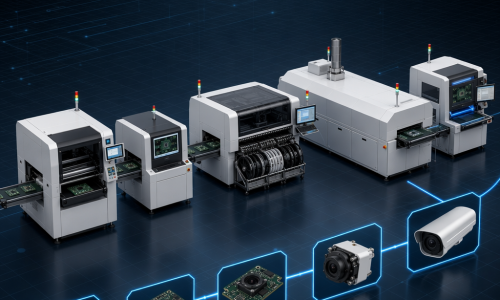
In the global electronics manufacturing services (EMS) sector, the efficiency, flexibility, and precision of SMT (Surface Mount Technology) lines directly determine a company’s competitiveness. Among SMT machine brands, the Panasonic NPM (Neo Production Modular) series stands out as an industry-standard benchmark, highly regarded for its modular architecture, extreme reliability, and dominant market share.
Faced with diverse product portfolios and shortening delivery cycles, manufacturing engineers often debate between two stellar models during Panasonic SMT machine selection: the NPM-D3 and the NPM-TT2. While both belong to the flagship NPM modular family, their core designs and hardware focuses are completely different.
This article provides an in-depth comparison of their positioning, technical specifications, and real-world assembly scenarios to help you select the ideal configuration for your SMT line.
1. Positioning Differences: Speed Demon vs. Flexibility King
To make an informed decision on SMT equipment, it is essential to understand how these two machines function within Panasonic’s modular line philosophy.
Panasonic NPM-D3: Ultra-High Speed, High-Precision Dual-Lane System
The NPM-D3 is engineered for high-density, massive volume, and ultra-high-speed placement. It represents the pinnacle of front-end high-speed placement:
- Extreme Throughput: Equipped with lightweight 16-nozzle heads, a single dual-module machine can reach an ideal placement speed of 84,000 CPH (and up to 92,000 CPH on the upgraded NPM-D3A).
- Micro-Component Accuracy: With a high-precision mode achieving $\pm25\ \mu\text{m}$ placement accuracy, it easily handles ultra-micro components down to 03015 and 0201 metric chips.
- Independent Dual-Lane Control: The dual-lane conveyor system allows independent, alternate board transport, virtually eliminating board transfer delays and maximizing the actual units-per-hour (UPH) yield.
Panasonic NPM-TT2: High-Flexibility, Multi-Functional, Odd-Form Master
The NPM-TT2 is a twin-tray, multi-functional platform engineered to handle heavy, tall, and odd-form components. It is the solid back-end anchor of SMT lines:
- Large & Odd-Form Component Handling: It supports the heavy-duty 3-nozzle head V2 or the versatile 8-nozzle head. The 3-nozzle head is custom-built to mount larger, tall, and heavy components like ICs, connectors, and shielding cans.
- Twin Tray Feeding: Features a robust tray feeding system (Twin Tray), allowing high-precision pick-and-place of high-value ICs, BGAs, and connector pins from matrix tray packages.
- Seamless Line Integration: In terms of footprint, rail heights, and control systems, the NPM-TT2 is 100% compatible with the NPM-D3. They can be connected inline to create a perfect “high-speed front + flexible back” SMT configuration.
2. Panasonic NPM-D3 Specs vs. NPM-TT2 Comparison
To facilitate engineering evaluation, we have compiled a detailed side-by-side comparison of the core technical parameters:
| Technical Specification | Panasonic NPM-D3 | Panasonic NPM-TT2 | Engineering Notes & Analysis |
|---|---|---|---|
| Machine Role | Ultra-high-speed, high-precision modular SMT mounter | Twin-tray, high-flexibility, multi-functional SMT mounter | NPM-D3 targets throughput; NPM-TT2 targets component range and trays. |
| Max Placement Speed (CPH) | Up to 84,000 ~ 92,000 CPH | Up to 18,000 ~ 20,000 CPH | Panasonic SMT throughput differs drastically; D3 is 4 to 5 times faster than TT2. |
| Placement Accuracy (Cpk $\ge$ 1) | Chip: $\pm40\ \mu\text{m}$ (high-precision mode: $\pm25\ \mu\text{m}$) | Chip: $\pm40\ \mu\text{m}$ / IC: $\pm30\ \mu\text{m}$ | Both offer high chip accuracy, but D3 excels at ultra-small chips. |
| Supported Placement Heads | 16-nozzle, 12-nozzle, 8-nozzle, 2-nozzle heads | 8-nozzle, 3-nozzle V2, and Dispensing heads | TT2 supports high-torque 3-nozzle heads and dispensing heads for adhesive/paste. |
| Component Size Range | 03015 microchip to L 120 $\times$ W 90 $\times$ T 28 mm | 0402 chip to L 120 $\times$ W 90 $\times$ T 28 (or L 150 $\times$ W 25 $\times$ T 30) mm | D3 supports smaller microchips; TT2 supports longer (150mm) and heavier odd-form parts. |
| Max PCB Dimensions | Single lane: L 510 $\times$ W 590 mm Dual lane: L 510 $\times$ W 300 mm (Optional L 750 $\times$ W 550 mm super-large board) | Single lane: L 510 $\times$ W 590 mm Dual lane: L 510 $\times$ W 300 mm (Completely identical conveyor system for seamless inline linkage) | Identical board capacity allows perfect mechanical and electronic line integration. |
| Feeder Slots / Capacity | Max 136 slots (using 8mm double-tape feeders) | Max 120 slots (pure feeder cart) or 40/80-level Tray configurations | D3 prioritizes large tape feeding; TT2 focuses on mixed tray and tape feeding. |
3. Real-World Line Configurations: Which Setup Fits Your Product?
Based on their technical features, we recommend the following line configurations for typical SMT production lines:
Scenario A: High-Density Consumer Electronics (Smartphones, Tablets, Wearables)
- Product Characteristics: Highly compact PCBs with high-density component populations. Over 90% of components are 0402, 0201, or 03015 resistors/capacitors. This requires extreme Panasonic SMT throughput and precision.
- Line Recommendation: An all-high-speed SMT line centered on NPM-D3.
- Recommended Setup:
NPM-D3 (with 16-nozzle heads) + NPM-D3 (with 16/8-nozzle heads). - Rationale: Running dual lanes at maximum speed, the 16-nozzle heads achieve unmatched performance with small chips. This ensures high-yield, massive-scale production.
- Recommended Setup:
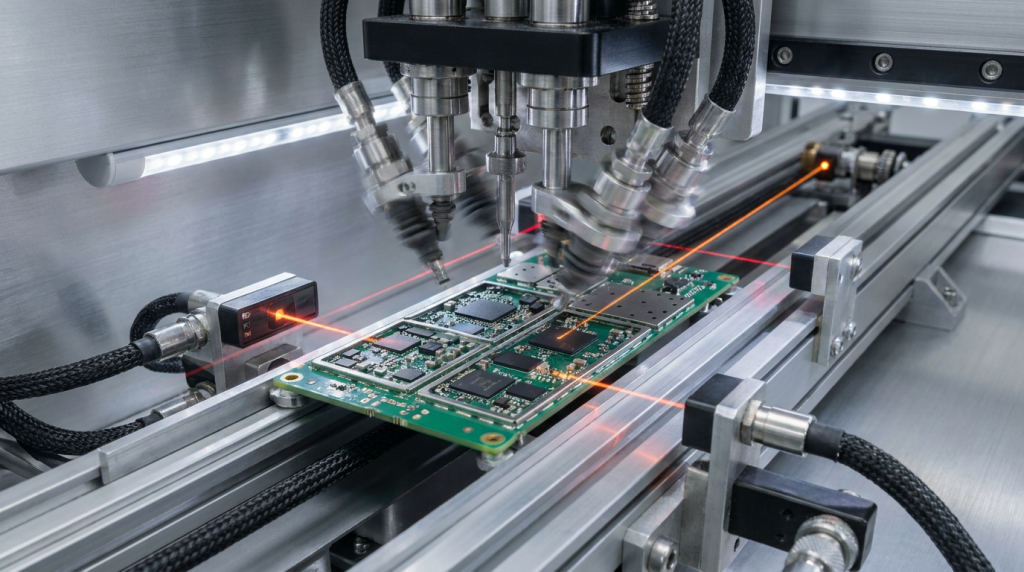
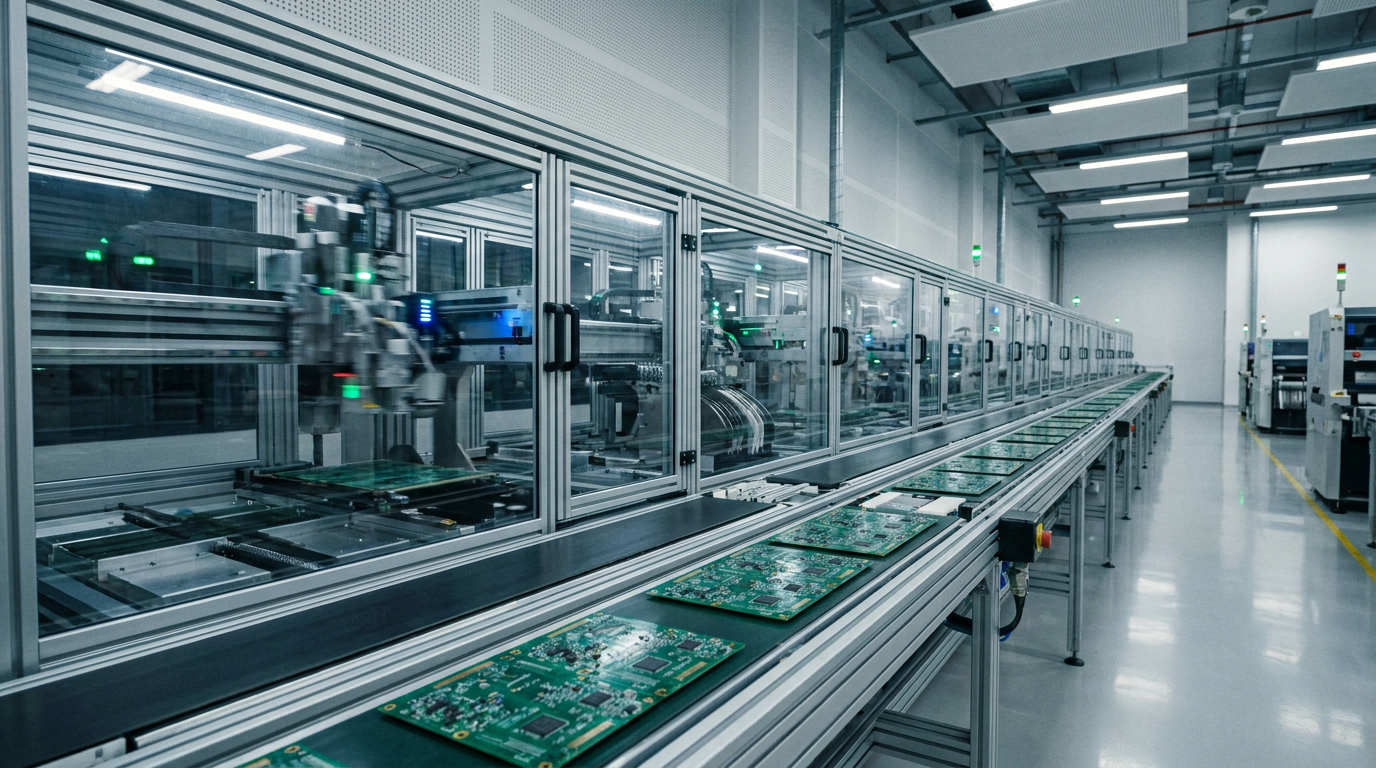
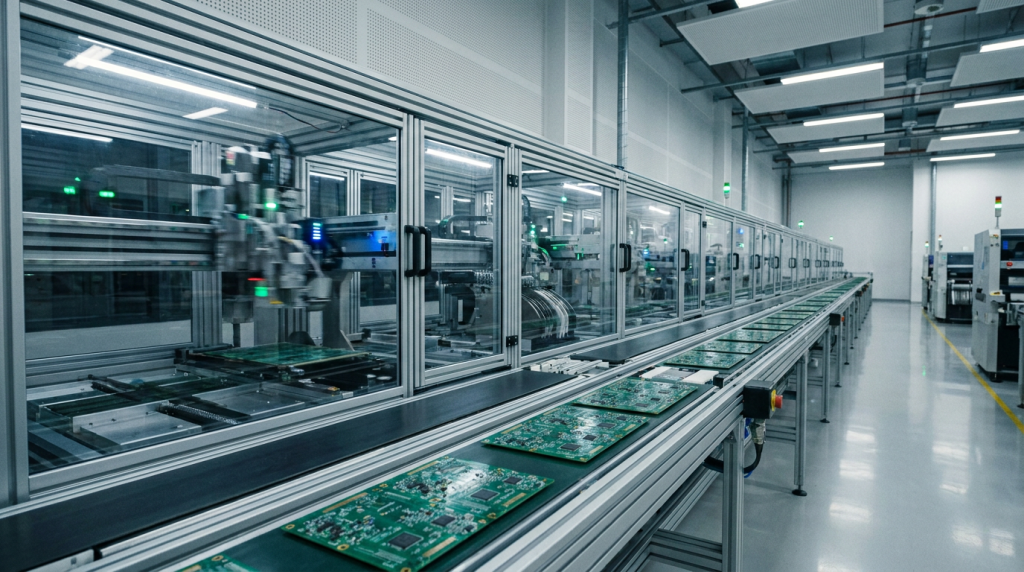
Figure 1: Panasonic NPM-D3 executing ultra-high-speed, high-precision placement on high-density smartphone PCBs.
Scenario B: Automotive Electronics, Industrial Controls, & Mixed Motherboards
- Product Characteristics: Large PCB dimensions with highly diverse components, including large ICs, BGAs, shielding cans, heavy inductors, and specialized connectors.
- Line Recommendation: The “Golden Balance” Line: NPM-D3 (Front-End) + NPM-TT2 (Back-End).
- Recommended Setup:
NPM-D3 (with 16/12-nozzle heads) + NPM-TT2 (with 8/3-nozzle V2 heads & Twin Tray). - Rationale: The NPM-D3 rapidly mounts the high-volume resistors, capacitors, and small transistors at the front. The NPM-TT2, equipped with heavy-duty 3-nozzle heads and twin trays, handles BGA chips, shielding covers, and heavy connector pins. This hybrid configuration avoids line bottlenecks and provides maximum efficiency for automotive electronic manufacturing.
- Recommended Setup:
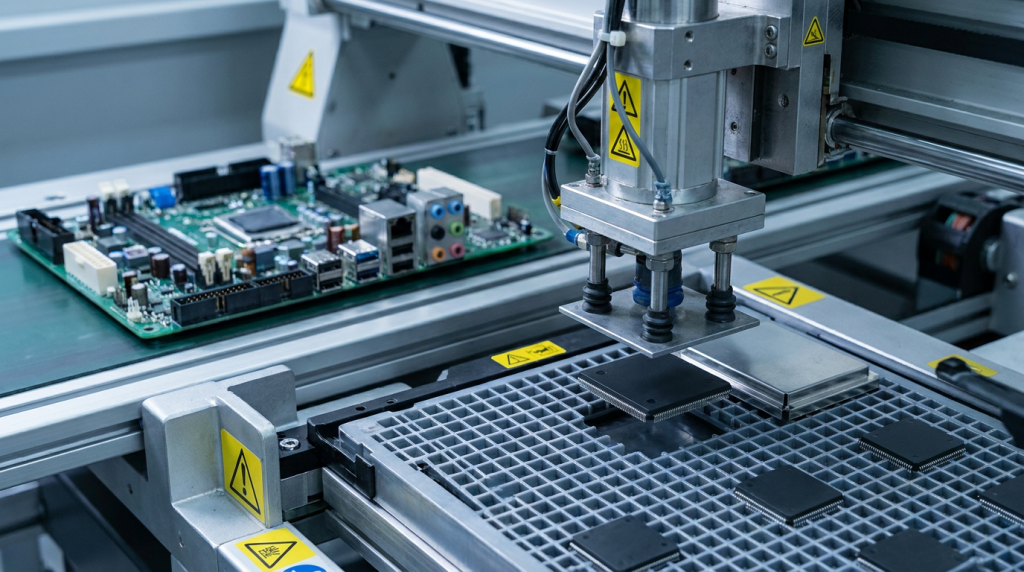
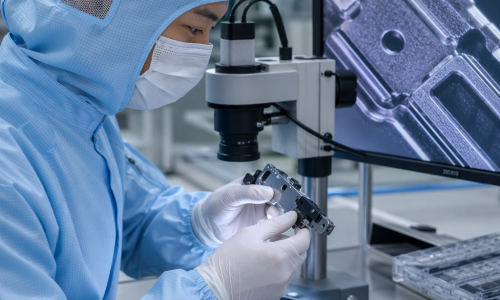
Figure 2: Panasonic NPM-TT2 head picking a large BGA chip from the Twin Tray feeder for high-precision odd-form mounting.
4. WeiHongChuang SMT Equipment Solutions: Your Reliable Partner
Choosing the right SMT model is only the first step. Ensuring continuous uptime, smooth line integration, and optimized cost of ownership is what drives manufacturing profitability.
As a leading provider of intelligent SMT equipment and services, WeiHongChuang is dedicated to providing complete, one-stop solutions for the Panasonic NPM series:
- Full Range of NPM Equipment For Sale & Lease: We supply high-quality Panasonic NPM-D3, NPM-D3A, NPM-TT2, and NPM-W2 mounters. We offer flexible purchase, lease, and trade-in options to optimize your capital expenditure and cash flow.
- Original Spare Parts & Consumables: We carry extensive inventory of original Panasonic placement heads (16/8/3 nozzles), original nozzles, electric tape feeders, stick feeders, vibration feeders, boards, and lasers—guaranteeing immediate shipment.
- Expert Engineering & Support: Our engineering team boasts over 10 years of experience with Panasonic SMT machines. We provide installation, calibration, operator training, yield optimization, preventive maintenance, and 24/7 on-site emergency repairs to ensure your production lines run without interruption.
5. Selection Summary: The SMT Decision Matrix
In summary, the core logic of Panasonic SMT machine selection is “match by component, balance by speed”:
- If your product is a consumer device dominated by microscopic chip components demanding massive volume, the NPM-D3 is your ultimate throughput engine.
- If your product is an automotive, industrial, or network board requiring diverse tray ICs, BGAs, and heavy connectors, integrating the NPM-TT2 will inject unmatched flexibility into your factory.
If you have further questions regarding your line balance, throughput capacity, or budget planning, contact WeiHongChuang today. Our SMT specialists will customize an optimal configuration for your manufacturing requirements.
(This article is published exclusively by WeiHongChuang SMT Equipment Research Institute. Please credit the source for any reproduction.)